


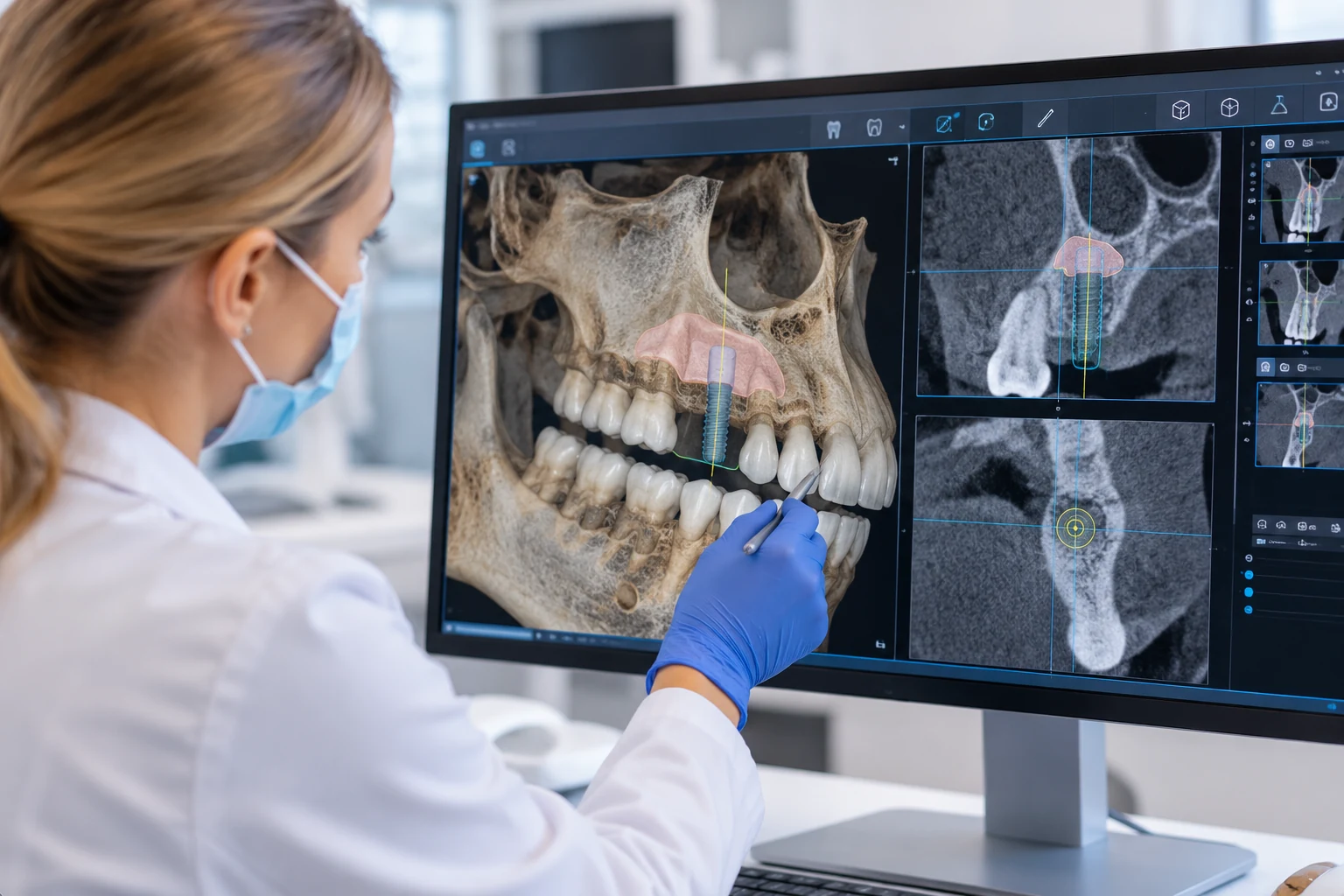
 CBCT-based site evaluation
 Staged or simultaneous options
 Versah® Densah® techniques when appropriate
 Implant plan drives the graft plan

Why does the ridge shrink?
Bone remodels after tooth loss. Infection, gum disease, trauma and long periods without a tooth can increase the amount or shape of ridge loss.

Is ridge augmentation the same as socket preservation?
No. Socket preservation is performed around the time of extraction to limit ridge loss. Ridge augmentation rebuilds a ridge that is already deficient.

Can the implant be placed at the same time?
Sometimes. Simultaneous placement depends on defect shape, soft tissue, the ability to achieve primary implant stability and whether the implant can still be positioned correctly.

Does every narrow ridge need a block graft?
No. Options include guided bone regeneration, particulate grafting, block grafts, ridge expansion and other techniques. The defect determines the approach.
THE RIDGE IS PART OF THE RESTORATION
A dental implant needs bone in the right place — not simply “enough bone somewhere”
The final crown, bridge or full-arch teeth determine where the implant ideally needs to emerge. If the ridge has resorbed toward the tongue, palate or vertically, placing an implant only where residual bone remains can create a compromised restorative position.
Ridge augmentation aims to create the volume and contour needed for a more appropriate implant position. In the esthetic zone, bone contour can also influence the gum profile and how the final restoration emerges from the tissue.
The decision is therefore restorative as much as surgical: first determine where the implant should be for the final tooth, then evaluate whether the existing ridge can support that position.
WHY RIDGES BECOME DEFICIENT
Bone loss has more than one cause
Understanding why the ridge is deficient helps determine whether the site is ready for augmentation and how the surrounding tissues should be managed.
Post-extraction remodeling
The socket and outer ridge remodel after a tooth is removed. The amount and direction of change vary by site and by the condition of the socket walls.
Periodontal disease or infection
Loss of bone around a failing tooth can leave a defect that is very different from a healthy extraction socket and may require staged treatment.
Trauma, anatomy or long-term tooth loss
Injury, developmental anatomy and years of resorption under a missing-tooth space or denture can leave a ridge that is narrow, concave or vertically deficient.
The graft technique should match the defect — not the other way around.
A small contour defect, a narrow ridge with a favorable bony envelope and a large vertical defect are different clinical problems. Bright Smiles evaluates the defect shape, bone quality, soft tissue, implant position and restorative goal before selecting the approach.
A TOOLBOX, NOT ONE GRAFT
How a deficient ridge can be managed
Several techniques can increase ridge dimensions or preserve the implant position. They are not interchangeable.
Guided bone regeneration (GBR)
Particulate graft material is placed where bone volume is needed and protected with a membrane to create a space for regeneration. The size and shape of the defect affect predictability.
Block or structural grafting
Larger defects may require a more structural graft approach. These procedures can provide meaningful volume but may involve greater surgical complexity and a staged healing period.
Ridge expansion / ridge split
Selected narrow ridges with favorable anatomy can sometimes be expanded rather than built outward with a traditional graft alone. The existing cortical and trabecular bone pattern matters.
Osseodensification-based expansion
Bright Smiles has clinical protocols using Versah® Densah® burs for selected ridge-expansion situations. Osseodensification can optimize and expand suitable existing bone; it does not create missing tissue out of nothing.
Hard + soft tissue contour development
Some implant sites need both bone and gum-tissue development. Soft-tissue thickness and contour can influence esthetics, cleansing access and long-term tissue stability.
Staged augmentation
When the defect is too large to achieve ideal implant position and stability at the same visit, bone can be developed first and the implant placed after healing.
TIMING THE IMPLANT
Can the implant be placed at the same appointment as ridge augmentation?
Sometimes. The key question is whether the implant can be placed in the correct restorative position with adequate primary stability while the deficient portion of the ridge is augmented.
For selected horizontal defects, simultaneous implant placement and augmentation can be predictable. When the defect is large, implant stability is inadequate, or the implant would have to be placed in a compromised position simply to “make it work,” a staged approach is usually the more controlled decision.
Vertical augmentation is generally more complex and less predictable than routine horizontal width development, so treatment expectations and alternatives deserve a careful discussion.
The plan favors staging when
- The implant cannot be stabilized in the planned position
- The defect is large or lacks containment
- Vertical height must be rebuilt
- Soft-tissue closure would be compromised
- Infection or tissue condition requires separate management
- The restorative position would otherwise be sacrificed
WHAT ACTUALLY GOES INTO A BONE GRAFT?
Bone-graft material can come from different sources
The material is selected based on defect size, technique, biologic goals and surgeon preference. The material does not simply act as a permanent filler.
Autogenous bone
Bone from the patient contains living cells and native bone matrix. It can be used alone or mixed with other materials, especially when biologic activity and structural grafting are important.
Donor or processed graft materials
Allograft and other processed materials can provide a scaffold for bone regeneration and may reduce the need for a separate donor site.
Membranes and stabilization
A membrane can protect the regenerative space from fast-growing soft tissue. Stable graft containment and tension-free soft-tissue closure are important parts of guided bone regeneration.
FROM DEFECT TO IMPLANT FOUNDATION
What the treatment process can look like
The timeline is driven by defect size, graft technique and whether implant placement is simultaneous or staged.
01 — Restorative goal
We identify the tooth or prosthesis being replaced and where the implant ideally needs to be positioned.
02 — CBCT evaluation
Three-dimensional imaging helps evaluate ridge width, height, defect morphology and nearby anatomy.
03 — Technique selection
We decide whether the site is better suited to GBR, ridge expansion, structural grafting, a staged approach or another method.
04 — Augmentation procedure
The ridge is developed according to the plan. The implant may or may not be placed at the same appointment.
05 — Protected healing
The grafted site needs time and stable soft-tissue coverage. Healing time varies with defect size, material and whether an implant was placed.
06 — Re-evaluation
Before moving to the next stage, the ridge and soft tissue are reassessed clinically and with imaging when indicated.
07 — Implant placement
If the implant was staged, it is placed once the site can support the planned position and stability.
08 — Restorative phase
After implant integration, the crown, bridge, overdenture or full-arch restoration is completed and long-term maintenance begins.
DIAGNOSIS + CONTROLLED SITE DEVELOPMENT
Bright Smiles combines 3D implant planning with site-development techniques
Technology is useful when it helps answer a clinical question: where the implant needs to be, what bone is missing, and which technique can develop the site without sacrificing the restorative plan.
CBCT-based planning
Bright Smiles implant protocols use CBCT to evaluate bone height, width, composition and restorative space before implant and augmentation procedures are planned.
Versah® Densah® techniques
Our clinical protocols include osseodensification, ridge expansion and guided expansion-graft approaches for selected anatomy. These methods depend on the existing bone envelope and are not appropriate for every defect.
Guided implant technology
When implant placement is part of the plan, Yomi is available in Cumming and X-Guide in Lawrenceville for appropriate cases. These technologies support implant placement; they do not replace the graft diagnosis.
WHAT PATIENTS SHOULD UNDERSTAND
Bone augmentation is predictable in appropriate cases, but it is not a guarantee
Possible complications include swelling, bruising, infection, wound opening or membrane exposure, incomplete bone gain, graft loss, need for additional augmentation, and changes to the planned implant timeline.
Larger and especially vertical defects generally carry more complexity than small contained horizontal defects. Smoking or nicotine use, uncontrolled periodontal disease, poor plaque control and systemic health factors can also affect healing.
The most important risk-control step is selecting the right procedure for the defect and creating a plan that can be maintained after the implant is restored.
Call before treatment if you have
- Active gum infection
- New swelling or drainage near the site
- Recent changes in medical history
- Medications affecting bone or healing
- Nicotine use you have not discussed
- A current sinus or respiratory infection for upper-jaw surgery
COST, INSURANCE & FINANCING
Understand the entire treatment plan — not just one procedure fee
Ridge augmentation cost varies with defect size, graft material, membrane use, whether a block or staged graft is required, sedation, and whether implant placement occurs at the same appointment or later.
The treatment plan should separate the site-development phase from the implant and restorative phases so you understand what each part is intended to accomplish.
We accept your insurance and will help you maximize your available benefits. Benefits for grafting and implant procedures vary by plan. Financing options may also be available for qualifying patients.
CARE CLOSE TO HOME
Implant care across Bright Smiles
Ridge-augmentation and implant planning are coordinated across Bright Smiles. Specific surgical techniques, technology and sedation options are selected according to the case and location.
Cumming
907 Buford Rd, Suite 100
Cumming, GA 30041
678-922-8282
Yomi® robotic implant guidance
IV sedation available for appropriate cases
Open Monday–Saturday, 8 AM–5 PM
Lawrenceville
845 Scenic Hwy S, Suite 300
Lawrenceville, GA 30046
770-277-5588
X-Guide® dynamic implant guidance
Monday–Friday, 8 AM–5 PM
Second and fourth Saturdays, 8 AM–5 PM
Dawsonville
78 Dawson Village Way N, Suite 170
Dawsonville, GA 30534
706-525-7127
Comprehensive Bright Smiles implant and restorative care
Monday–Friday, 8 AM–5 PM
FREQUENTLY ASKED QUESTIONS
Ridge augmentation questions, answered clearly
What is ridge augmentation?
Ridge augmentation is a group of procedures used to rebuild or reshape deficient jawbone so a dental implant can be placed in a more appropriate position and the final restoration can be supported.
Why did I lose bone after a tooth was removed?
Jawbone remodels after tooth loss. Infection, gum disease, trauma and the condition of the extraction socket can increase the amount or shape of ridge loss.
Is ridge augmentation the same as socket preservation?
No. Socket preservation is performed at or near the time of extraction to reduce ridge collapse. Ridge augmentation treats a ridge that is already deficient.
Do I need a bone graft for every dental implant?
No. Grafting is recommended only when the existing ridge cannot support the planned implant position or tissue contour adequately.
Can the implant be placed at the same time as the graft?
Sometimes. Simultaneous placement depends on defect shape, soft tissues and the ability to achieve primary implant stability in the correct restorative position.
What is guided bone regeneration?
GBR uses graft material and a barrier membrane to maintain a protected space where new bone can develop. The technique is commonly used for horizontal ridge defects and contour augmentation.
What is ridge expansion?
Ridge expansion increases the width of selected narrow ridges by gradually expanding suitable existing bone. It requires a favorable bony shape and is not appropriate for every resorbed ridge.
What is osseodensification?
Osseodensification is a drilling approach that can densify and expand suitable bone during osteotomy preparation. Bright Smiles has Versah Densah protocols for selected implant and ridge-expansion cases.
Does osseodensification replace bone grafting?
No. It can optimize suitable existing bone in selected anatomy, but it does not create tissue that is not present. Significant defects may still need grafting or a staged approach.
How long does ridge augmentation take to heal?
Healing varies by defect size, material, technique and whether an implant was placed at the same time. Many grafts require several months before the next stage, but your specific timeline is determined after treatment.
Is vertical bone grafting harder than widening a ridge?
Vertical augmentation is generally more complex and less predictable than routine horizontal ridge-width augmentation. The need, benefits and alternatives should be discussed carefully.
Will I be sedated?
Sedation depends on the procedure, health history and patient preference. Nitrous oxide is available across Bright Smiles offices, and IV sedation is currently available in Cumming for appropriate cases.
Can a failed graft be treated again?
Often there are additional options, but the reason for incomplete healing or graft loss should be identified before repeating or changing the technique.
Does insurance cover ridge augmentation?
We accept your insurance and will help you understand and maximize the benefits available to you. Coverage varies by plan and by the relationship of the graft to implant treatment.
RELATED CARE
Build the treatment plan around the whole mouth
Do not compromise the implant position just to avoid talking about the bone.
If the ridge is deficient, the right question is whether it can be developed predictably enough to support the restoration you actually want.
We will evaluate the defect, explain whether augmentation is necessary, compare simultaneous and staged options, and build the implant plan around the final tooth position.
Cumming • Lawrenceville • Dawsonville
3D implant planning • Advanced implant technology • Sedation options