


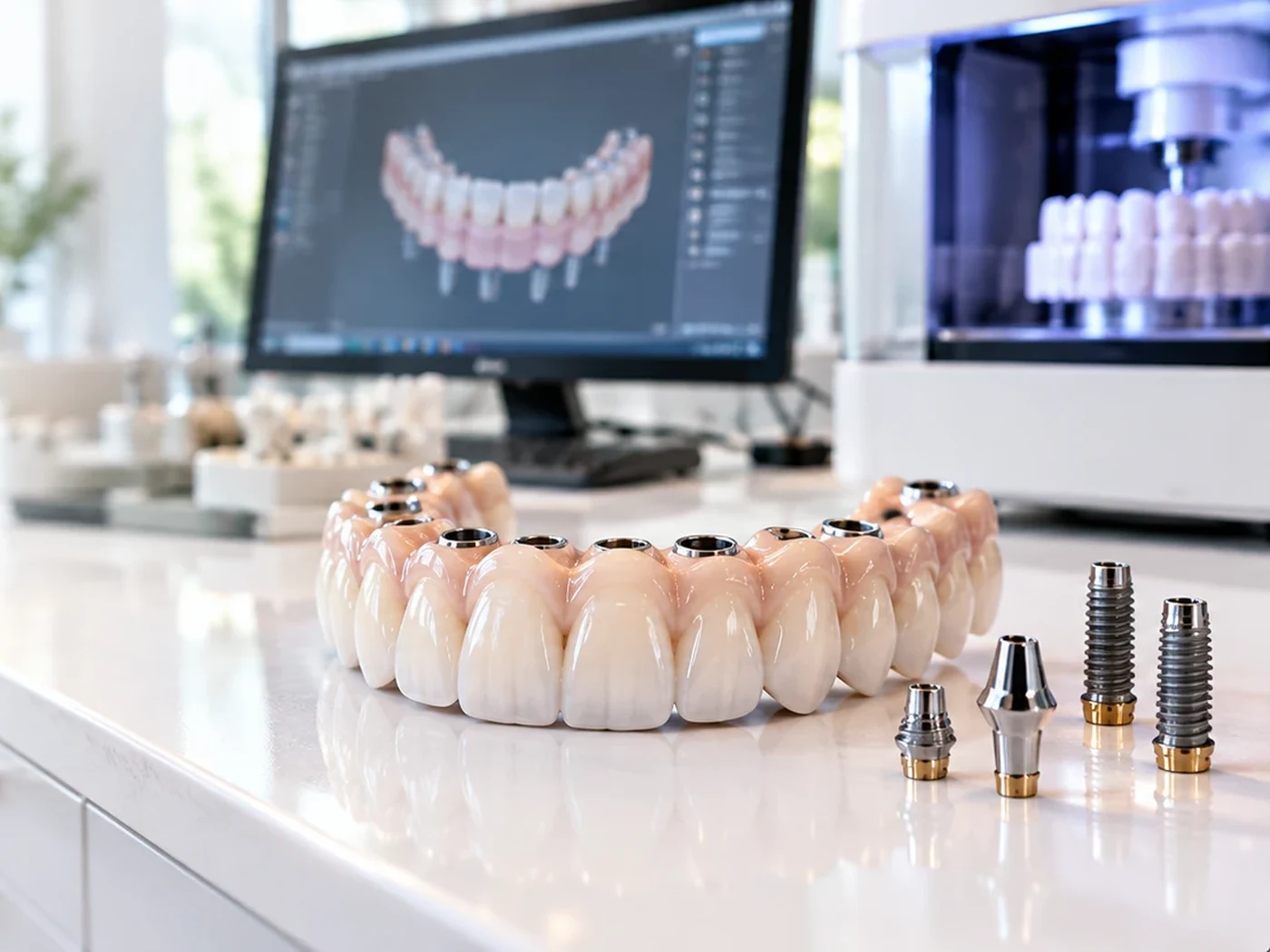
 Fixed full-arch final restoration
 Digital design & restorative planning
 Maintenance still required
 3 offices • coordinated care

Is zirconia the implant?
No. Dental implants are the anchors in bone. Zirconia is a restorative material used to fabricate the teeth and supporting prosthetic structure.

Is it removable?
A fixed zirconia full-arch prosthesis is secured to implants and is not removed by the patient for routine daily cleaning.

Is zirconia unbreakable?
No dental prosthesis is indestructible. Material, design, thickness, bite, parafunction, implant support and maintenance all influence long-term performance.

Is zirconia always the final material?
Not automatically. The final prosthesis should be selected after considering restorative space, esthetics, bite, hygiene and the overall implant plan.
FROM SURGERY TO THE TEETH YOU LIVE WITH
Full-arch implant treatment is not finished when the implants integrate
The surgical phase creates the implant foundation. The restorative phase determines the teeth you see, speak with, chew with and clean around every day. A successful full-arch case needs both phases to be planned together.
During treatment, many patients wear a provisional prosthesis made from a different material while tissues heal and the bite, tooth position and esthetics are evaluated. The final restoration can then be designed using what was learned during that provisional phase.
Zirconia is one option for that final restoration. It is valued for strength, wear resistance, color stability and the ability to be digitally designed and milled with precise contours. But material selection is only one part of the design.
MATERIAL + DESIGN
What makes zirconia different?
The term “zirconia teeth” can make it sound like one standardized product. In reality, the design can vary substantially.
Monolithic zirconia
Much of the prosthesis is milled from a single zirconia structure. This can reduce reliance on veneering porcelain in high-stress areas and may reduce some types of chipping compared with heavily veneered designs.
Characterized or layered esthetics
Selected areas can be stained, glazed or layered to improve translucency, tooth form or pink-tissue characterization. More esthetic layering can also introduce different repair and chipping considerations.
Connection to the implants
The restoration may use titanium bases, screws and other components to connect the zirconia prosthesis to the implants. Access, retrievability and passive fit are part of the engineering.
The goal is not “a zirconia bridge.” The goal is a full-arch restoration that fits the implants, the face, the bite and the patient.
A material can perform well in one design and poorly in another. Bright Smiles plans full-arch restorations around implant position, prosthetic space, esthetic needs, occlusion, cleaning access and how the restoration can be serviced in the future.
WHAT HAS TO BE DESIGNED
A full-arch prosthesis has to solve several problems at once
It replaces teeth, and often replaces lost gum and bone volume visually. That makes the design very different from simply placing several individual crowns.
Tooth position & smile display
Incisor position affects lip support, smile arc, tooth display and speech. The final tooth position should be evaluated before the definitive restoration is made.
Pink-tissue replacement
When substantial bone and gum volume has been lost, the prosthesis may include pink restorative material to recreate tissue contours and keep tooth proportions natural.
Cleaning access
The underside needs enough access for the patient to clean around the implants without creating a bulky design that traps food unnecessarily.
Speech & phonetics
Tooth position, palatal or lingual contours, vertical dimension and the transition between prosthesis and tissue can influence speech. Provisional restorations can help test these factors.
Occlusion & opposing teeth
The bite must account for what opposes the restoration — natural teeth, another implant prosthesis, a denture or a combination. Forces should be distributed intentionally.
Restorative space
Zirconia needs adequate dimensions for strength and design. Implant position and available vertical space influence whether the material can be used appropriately.
DIGITAL FULL-ARCH RESTORATION
From provisional teeth to the definitive zirconia prosthesis
The exact appointments vary, but the final restoration should be built from verified records rather than simply copying a generic tooth setup.
01 — Confirm the foundation
We evaluate implant integration, soft tissues, implant positions and the restorative space available for the final prosthesis.
02 — Capture accurate records
Digital scans, implant scan bodies, photographs, bite records and other records help transfer the implant positions and desired tooth setup into the restorative workflow.
03 — Verify fit & position
Complex full-arch cases may require verification steps so the laboratory record accurately represents the implant positions before the definitive prosthesis is fabricated.
04 — Refine the smile design
Tooth length, midline, incisal edge position, shade, gum contours and lip support are evaluated against the patient’s face and provisional experience.
05 — Design the occlusion
The bite is planned around implant support, opposing teeth, parafunction and the need to protect both the prosthesis and implants.
06 — Mill & finish the prosthesis
The zirconia restoration is digitally designed and fabricated, then characterized and finished according to the esthetic and functional plan.
07 — Deliver & torque components
The prosthesis is seated, fit and bite are verified, and the retaining components are secured according to the restorative design.
08 — Begin long-term maintenance
Access openings, screws, bite, hygiene spaces, implants, bone levels and soft tissues remain part of ongoing care.
WHAT THE MATERIAL CAN — AND CANNOT — PROMISE
Modern monolithic zirconia full-arch prostheses have encouraging clinical performance, but long-term success is more than a survival percentage
Recent systematic reviews report high short- to medium-term survival for monolithic zirconia complete-arch prostheses. They also emphasize that the evidence is heterogeneous and that technical and biologic complications still occur.
Monolithic designs tend to have less veneer chipping than restorations that rely heavily on layered veneering ceramic. That does not eliminate risks such as screw-related issues, access-filling wear, fractures, prosthetic wear, peri-implant disease or changes in the bite.
This is why Bright Smiles does not describe zirconia as “permanent” or “unbreakable.” It is a restorative material within a maintained implant system.
What still has to be maintained
- Implant tissues and bone levels
- Screw and component stability
- Occlusion and wear
- Access-hole materials
- Hygiene under the prosthesis
- Night-guard use when prescribed
SURGICAL + RESTORATIVE DIGITAL PLANNING
The final zirconia teeth are only as good as the foundation and records behind them
Digital workflows can connect implant planning, provisional tooth position and definitive restoration design. The technology supports the clinical plan; it does not replace diagnosis or verification.
3D implant planning
CBCT and restorative planning help position implants where the final full-arch prosthesis can be supported and cleaned, rather than placing implants without regard to the restorative endpoint.
Yomi® in Cumming
For appropriate implant procedures, Yomi can help translate a digital implant plan during surgery while the dentist remains in control.
X-Guide® in Lawrenceville
For appropriate implant procedures, X-Guide provides real-time navigation relative to the digital plan. The final restorative design still depends on accurate records and prosthetic planning.
CANDIDACY
Who may be a candidate for zirconia full-arch teeth?
The material decision comes after the larger decision that a fixed full-arch implant restoration is appropriate.
Patients replacing a complete arch
Zirconia may be considered when a patient is receiving a fixed implant-supported full-arch restoration and the available space and implant design support it.
Patients completing a provisional phase
A provisional restoration can provide information about tooth position, bite, esthetics and hygiene before committing those decisions to a definitive zirconia prosthesis.
Patients able to maintain the restoration
Fixed full-arch teeth require daily cleaning under the prosthesis and professional implant maintenance. A material choice cannot compensate for an unmaintainable design or poor home care.
COST, INSURANCE & FINANCING
Understand the entire treatment plan — not just one procedure fee
The cost of a zirconia full-arch restoration is part of the broader full-arch treatment plan. Fees can be affected by implant surgery, extractions, grafting, sedation, provisional teeth, the number and type of implant components, laboratory design and the definitive prosthetic material.
If you already have implants or a provisional full-arch restoration, the restorative evaluation must determine whether the existing implant positions, components and restorative space can support the proposed final design.
We accept your insurance and will help you maximize your available benefits. Coverage for full-arch implant treatment varies significantly by plan. Financing options may also be available for qualifying patients.
CARE CLOSE TO HOME
Implant care across Bright Smiles
Bright Smiles can evaluate the surgical and restorative phases of full-arch implant care. Technology and sedation availability vary by location, and the treatment sequence is coordinated around the individual case.
Cumming
907 Buford Rd, Suite 100
Cumming, GA 30041
678-922-8282
Yomi® robotic implant guidance
IV sedation available for appropriate cases
Open Monday–Saturday, 8 AM–5 PM
Lawrenceville
845 Scenic Hwy S, Suite 300
Lawrenceville, GA 30046
770-277-5588
X-Guide® dynamic implant guidance
Monday–Friday, 8 AM–5 PM
Second and fourth Saturdays, 8 AM–5 PM
Dawsonville
78 Dawson Village Way N, Suite 170
Dawsonville, GA 30534
706-525-7127
Comprehensive Bright Smiles implant and restorative care
Monday–Friday, 8 AM–5 PM
FREQUENTLY ASKED QUESTIONS
Zirconia full-arch questions, answered clearly
What are zirconia full-arch teeth?
They are a fixed full-arch implant prosthesis fabricated primarily from zirconia ceramic and secured to dental implants. The exact design, connection and amount of pink restorative material can vary.
Is zirconia the same thing as the dental implants?
No. The implants are the components anchored in bone. Zirconia is the restorative material used for the full-arch teeth and prosthetic structure.
Are zirconia full-arch teeth removable?
A fixed full-arch zirconia restoration is not removed by the patient for routine cleaning. A dentist can remove the prosthesis when clinically necessary if the design is retrievable.
Is monolithic zirconia unbreakable?
No. Zirconia is strong, but no dental prosthesis is indestructible. Design, thickness, bite, parafunction, implant support and maintenance all affect performance.
Why use monolithic zirconia instead of acrylic or composite?
Zirconia offers different strength, wear and surface characteristics and can reduce some types of veneer or denture-tooth wear. Acrylic or composite-based provisional and definitive designs have their own advantages. The choice should be case-specific.
Will zirconia look too white or artificial?
It does not have to. Shade, translucency, tooth shape, surface texture and pink-tissue characterization can be customized. Esthetics depend on the design and finishing, not simply the material name.
Will I wear temporary teeth first?
Many full-arch cases use a provisional restoration before the definitive prosthesis. The provisional phase can help evaluate healing, bite, esthetics, speech and cleaning before the final restoration is made.
Can zirconia full-arch teeth chip?
They can. Monolithic designs reduce reliance on veneering ceramic, which can reduce certain chipping problems, but fractures, wear or other technical complications are still possible.
How do I clean under a fixed zirconia bridge?
Cleaning typically requires access under the prosthesis with tools such as floss threaders, specialized floss, interdental aids or water irrigation as instructed. Your specific routine depends on the contour and implant positions.
Do zirconia full-arch teeth need professional maintenance?
Yes. The implants, gums, bone levels, bite, screws, access openings and prosthesis all need periodic evaluation.
Can zirconia be repaired if something happens?
Some issues can be repaired intraorally or by removing the prosthesis, while major damage may require laboratory repair or replacement. Retrievability is one reason the restorative design matters.
What if I grind my teeth?
Grinding or clenching does not automatically rule out zirconia, but it affects occlusal design, material risk and whether a protective appliance is recommended.
Can I replace an existing acrylic full-arch bridge with zirconia?
Sometimes. The implants, component system, implant positions, restorative space, bite and condition of the existing prosthesis must be evaluated before deciding whether conversion is appropriate.
Does insurance cover zirconia full-arch implant teeth?
We accept your insurance and will help you understand and maximize the benefits available to you. Coverage varies by plan and by the surgical and restorative procedures involved.
RELATED CARE
Build the treatment plan around the whole mouth
Choose the final teeth with the same care used to plan the implants.
If you are considering full-arch treatment, already have provisional implant teeth, or are evaluating a new definitive prosthesis, the material should be selected after the implant positions, space, bite, esthetics and maintenance needs are understood.
We can evaluate whether zirconia is appropriate for your case and explain the alternatives without treating one material as the answer for everyone.
Cumming • Lawrenceville • Dawsonville
3D implant planning • Advanced implant technology • Sedation options