

 CBCT-based sinus & bone evaluation
 Crestal and lateral approaches
 Versah® Densah® protocols when appropriate
 Staged or simultaneous implant placement

Why is the sinus involved?
The sinus sits directly above the roots of the upper back teeth. Tooth loss and bone remodeling can leave limited vertical bone between the ridge and sinus floor.

Does every upper implant need a sinus lift?
No. It is considered when the planned implant site lacks the bone height needed for the implant position and another approach is not preferable.

Can the implant be placed the same day?
Sometimes. Simultaneous placement depends on residual bone, implant stability, sinus anatomy and the amount of elevation required.

Is there more than one technique?
Yes. Crestal/internal and lateral-window approaches are selected based on anatomy, available bone and the amount of augmentation needed.
ANATOMY DRIVES THE DECISION
Why upper molar and premolar implant sites are different
The posterior maxilla often has softer bone than other areas of the jaw, and the sinus floor can lie close to the crest where an implant would need to be placed. After tooth loss, two processes can reduce the available vertical bone: the ridge remodels from below while the sinus may pneumatize from above.
A sinus augmentation changes that anatomy by gently elevating the sinus membrane and creating a protected space for bone regeneration. The goal is not to “fill the sinus.” The goal is to develop bone beneath the elevated membrane while preserving sinus health.
The amount of existing bone, the size and shape of the sinus, septa, membrane anatomy, implant length and the ability to obtain primary stability determine which technique is appropriate.
WHY BONE HEIGHT CAN BE LIMITED
Several factors can reduce available bone in the upper back jaw
The diagnosis should identify the reason and the amount of deficiency before a surgical approach is selected.
Tooth loss & ridge remodeling
When upper molars or premolars are lost, the alveolar ridge can shrink vertically and horizontally.
Sinus pneumatization
The sinus can expand into the space previously occupied by tooth roots, reducing the vertical bone available for a future implant.
Periodontal disease or prior infection
Bone loss around failing teeth or previous infection can further reduce the remaining ridge and may change whether treatment should be staged.
The goal is an implant in the right restorative position with a healthy, maintainable sinus and bone environment.
If the existing bone can support the planned implant without sinus augmentation, there is no benefit to adding surgery. If the implant cannot be placed predictably because the sinus limits bone height, augmentation can create a better foundation.
MORE THAN ONE WAY TO ELEVATE THE SINUS
Crestal and lateral approaches solve different amounts of vertical deficiency
Your CBCT and implant plan determine whether a smaller internal approach or a broader lateral-window approach makes more sense.
Crestal / internal elevation
The sinus floor is approached through the implant osteotomy from the crest of the ridge. It is generally used when a smaller amount of elevation is required and the anatomy is favorable.
Osseodensification-assisted elevation
Bright Smiles has Versah® Densah® protocols for selected crestal sinus-lift cases. The burs can be used in densifying mode to prepare the osteotomy and facilitate controlled elevation in appropriate anatomy.
Lateral-window sinus augmentation
A window is created from the side of the upper jaw to access and elevate the sinus membrane. This approach is used when a larger amount of vertical development is required or the anatomy is less suited to a crestal technique.
SIMULTANEOUS OR STAGED?
Can the implant be placed at the same time as the sinus lift?
In some cases, yes. When enough native bone remains to stabilize the implant in the correct position, the implant and sinus augmentation can sometimes be performed at the same appointment.
When residual bone is limited, primary stability is uncertain, the augmentation is extensive or the sinus condition needs separate management, the safer plan may be to graft first and place the implant after the site develops.
Combining procedures can shorten the total number of surgical stages, but reducing appointments should never take priority over implant stability and a healthy sinus environment.
A staged approach may be preferred when
- Residual bone cannot stabilize the implant
- A larger lateral augmentation is required
- There is active sinus disease or unresolved symptoms
- Membrane or anatomy increases surgical complexity
- The implant position would be compromised
- Additional ridge augmentation is also needed
WHAT WE LOOK AT ON THE CBCT
A sinus lift should be planned from three-dimensional anatomy
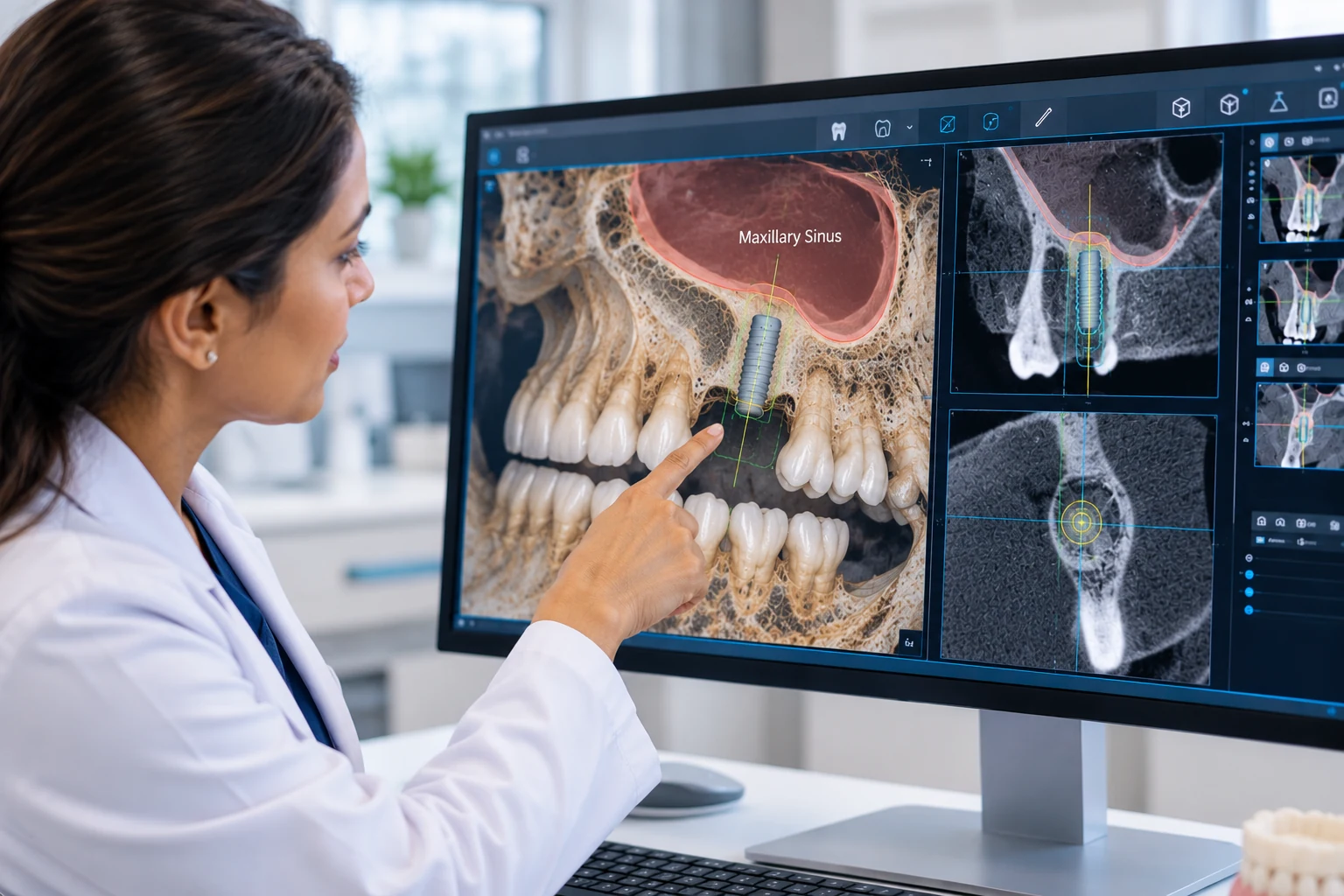
A panoramic image can provide an overview, but CBCT can answer questions about the implant site and sinus in three dimensions.
Residual bone height & width
We measure the bone available beneath the sinus and evaluate whether the ridge can support the planned implant diameter and position.
Sinus anatomy & septa
Sinus shape, bony septa and membrane contour can affect access and the choice between crestal and lateral approaches.
Sinus health
Mucosal thickening, active symptoms, prior sinus surgery or other findings may require additional evaluation before elective augmentation is performed.
WHAT FILLS THE NEW SPACE?
The elevated membrane creates a compartment where bone can develop
Different graft strategies can be used depending on the technique, amount of elevation and clinician’s plan.
Autogenous bone
The patient’s own bone can contribute biologic activity and may be combined with other graft materials.
Processed graft materials
Allograft, xenograft or synthetic materials can provide scaffold and volume while native bone remodels into the site.
Blood clot / autogenous bone in selected crestal techniques
Some minimally invasive elevation approaches can use the patient’s own bone and biologic healing response with little or no added graft material. The technique is anatomy-dependent.
FROM 3D PLAN TO IMPLANT FOUNDATION
What the treatment process can look like
The sequence depends on how much bone remains and whether the implant is placed simultaneously.
01 — Implant consultation
We confirm that an implant is the appropriate tooth-replacement option and identify the final restorative position.
02 — CBCT evaluation
We assess residual bone, sinus anatomy, ridge width, nearby teeth and any findings that could change elective sinus surgery.
03 — Select the approach
Crestal, osseodensification-assisted or lateral-window augmentation is selected according to the amount of elevation and anatomy.
04 — Sinus augmentation
The membrane is elevated and the space beneath it is managed according to the selected graft protocol.
05 — Implant placement when appropriate
If native bone provides adequate stability, the implant may be placed at the same visit. Otherwise implant placement is staged.
06 — Healing period
The augmented site is protected while new bone develops. The length of healing varies with the procedure and whether an implant was placed.
07 — Implant restoration
After the implant is integrated and ready, the crown, bridge or larger prosthetic plan is completed.
08 — Long-term maintenance
The implant, surrounding tissues, bite and restoration require ongoing home care and professional evaluation.
TECHNOLOGY SHOULD SUPPORT THE ANATOMY
Bright Smiles uses 3D planning and selected site-development technologies
The sinus is not a procedure to plan from guesswork. Our implant protocols emphasize three-dimensional evaluation of bone and restorative space before surgery.
CBCT planning
CBCT is used in Bright Smiles implant planning to evaluate bone height, width, anatomy and the proposed implant position in three dimensions.
Versah® Densah® protocols
Our clinical protocols include maxillary sinus-lift approaches using Versah Densah burs for selected cases with appropriate residual bone and ridge anatomy.
Guided implant placement
When implant placement is part of the same or later stage, Yomi in Cumming and X-Guide in Lawrenceville are available for appropriate cases to support translation of the digital implant plan.
RISKS & RECOVERY
The sinus membrane is delicate, and sinus augmentation deserves a real risk discussion
The Schneiderian membrane lining the sinus can perforate during surgery. Small perforations can often be managed, while larger problems may require a change in technique or staging.
Other risks include swelling, bruising, bleeding, infection, sinus symptoms, graft loss, incomplete bone development and failure of an implant to integrate. Existing sinus disease can increase complexity.
Post-operative instructions often include precautions intended to limit pressure changes in the sinus. Follow the written instructions given for your specific procedure rather than relying on generic internet advice.
Tell us before surgery about
- Current sinus infection or congestion
- Recent upper respiratory illness
- History of chronic sinus disease
- Prior sinus surgery
- Nicotine use
- Medications or conditions affecting healing
COST, INSURANCE & FINANCING
Understand the entire treatment plan — not just one procedure fee
Sinus-lift cost varies with the surgical approach, graft material, amount of augmentation, sedation, whether ridge augmentation is also needed, and whether the implant is placed at the same appointment or in a later stage.
The treatment plan should show the sinus augmentation, implant and restorative phases separately enough that you understand what each part is intended to accomplish.
We accept your insurance and will help you maximize your available benefits. Coverage for sinus augmentation and implant treatment varies by plan. Financing options may also be available for qualifying patients.
CARE CLOSE TO HOME
Implant care across Bright Smiles
Sinus-augmentation and implant care are planned across Bright Smiles according to anatomy, procedure complexity, technology and sedation needs.
Cumming
907 Buford Rd, Suite 100
Cumming, GA 30041
678-922-8282
Yomi® robotic implant guidance
IV sedation available for appropriate cases
Open Monday–Saturday, 8 AM–5 PM
Lawrenceville
845 Scenic Hwy S, Suite 300
Lawrenceville, GA 30046
770-277-5588
X-Guide® dynamic implant guidance
Monday–Friday, 8 AM–5 PM
Second and fourth Saturdays, 8 AM–5 PM
Dawsonville
78 Dawson Village Way N, Suite 170
Dawsonville, GA 30534
706-525-7127
Comprehensive Bright Smiles implant and restorative care
Monday–Friday, 8 AM–5 PM
FREQUENTLY ASKED QUESTIONS
Sinus lift questions, answered clearly
What is a sinus lift?
A sinus lift, sinus augmentation or sinus-floor elevation is a procedure that raises the sinus membrane and creates space for bone development in the upper back jaw so an implant can be supported.
Why would I need a sinus lift for a dental implant?
The maxillary sinus sits above the upper premolar and molar region. Tooth loss and bone remodeling can leave too little vertical bone for the planned implant position.
Does everyone getting an upper molar implant need a sinus lift?
No. It is considered only when available bone height is inadequate for the planned implant and another treatment strategy is not preferable.
What is the difference between an internal and lateral sinus lift?
An internal or crestal approach reaches the sinus through the implant osteotomy and is used for selected cases needing a smaller elevation. A lateral-window approach accesses the sinus from the side and can manage larger deficiencies.
What is a Densah sinus lift?
Versah Densah burs can be used in a densifying mode for selected crestal sinus-elevation procedures. Bright Smiles has clinical protocols for this technique when the anatomy is appropriate.
Can the implant be placed at the same time?
Sometimes. Simultaneous placement depends on having enough native bone to stabilize the implant in the correct position and on the amount of augmentation required.
How long does a sinus lift take to heal?
Healing takes several months in many cases, but the timeline varies with the technique, graft volume, residual bone and whether the implant was placed simultaneously.
What graft material is used?
Different cases may use the patient’s own bone, processed donor material, other graft substitutes, or a combination. Some selected crestal techniques may rely more on autogenous bone and the healing clot.
Can the sinus membrane tear?
Yes. Membrane perforation is a known complication. Small perforations can often be managed, while larger ones may change the procedure or require staging.
Can a sinus lift cause sinus problems?
Temporary sinus pressure or congestion can occur, and infection or sinusitis is a potential complication. Existing sinus disease should be discussed before elective augmentation.
What if I have chronic sinus problems?
Tell us before treatment. Depending on symptoms, imaging and history, additional medical or ENT evaluation may be appropriate before elective sinus surgery.
Will I be sedated?
Sedation depends on the procedure and patient. Nitrous oxide is available across Bright Smiles offices, and IV sedation is currently available in Cumming for appropriate cases.
Can a sinus lift be combined with ridge augmentation?
Yes, some upper-jaw sites are deficient in both vertical bone beneath the sinus and ridge width. The procedures may be combined or staged depending on the defect and implant plan.
Does insurance cover a sinus lift?
We accept your insurance and will help you understand and maximize the benefits available to you. Coverage varies by plan and by how the sinus augmentation relates to implant treatment.
RELATED CARE
Build the treatment plan around the whole mouth
Limited bone under the sinus does not automatically mean “no implant.”
It means the anatomy needs to be measured, the final tooth position needs to be planned, and the implant and graft sequence need to make sense together.
We will explain whether sinus augmentation is needed, which approach fits the site, and whether implant placement should be simultaneous or staged.
Cumming • Lawrenceville • Dawsonville
3D implant planning • Advanced implant technology • Sedation options