


 Removable for daily cleaning
 Implants help improve retention
 Fixed options also available
 3 offices • coordinated care

Is it still removable?
Usually, yes. The patient removes an implant overdenture for cleaning. A fixed full-arch restoration is a different treatment.

How many implants are needed?
There is no single number for every patient. Two implants are a common lower-overdenture design, but arch, anatomy, attachments and goals can change the plan.

Can my current denture be used?
Sometimes an existing denture can be adapted during treatment, but fit, tooth position, strength and available space have to be evaluated.

Does it eliminate denture maintenance?
No. The denture, attachments, implants, gums and bite still require daily care and professional maintenance.
A MIDDLE GROUND MANY PATIENTS MISS
A removable denture and a fixed full-arch bridge are not the only two choices
Conventional dentures rely on the shape of the gums, ridge, saliva, muscle control and denture fit for retention. Some people adapt very well. Others struggle with movement, food underneath the denture, adhesive use or a lower denture that never feels stable enough.
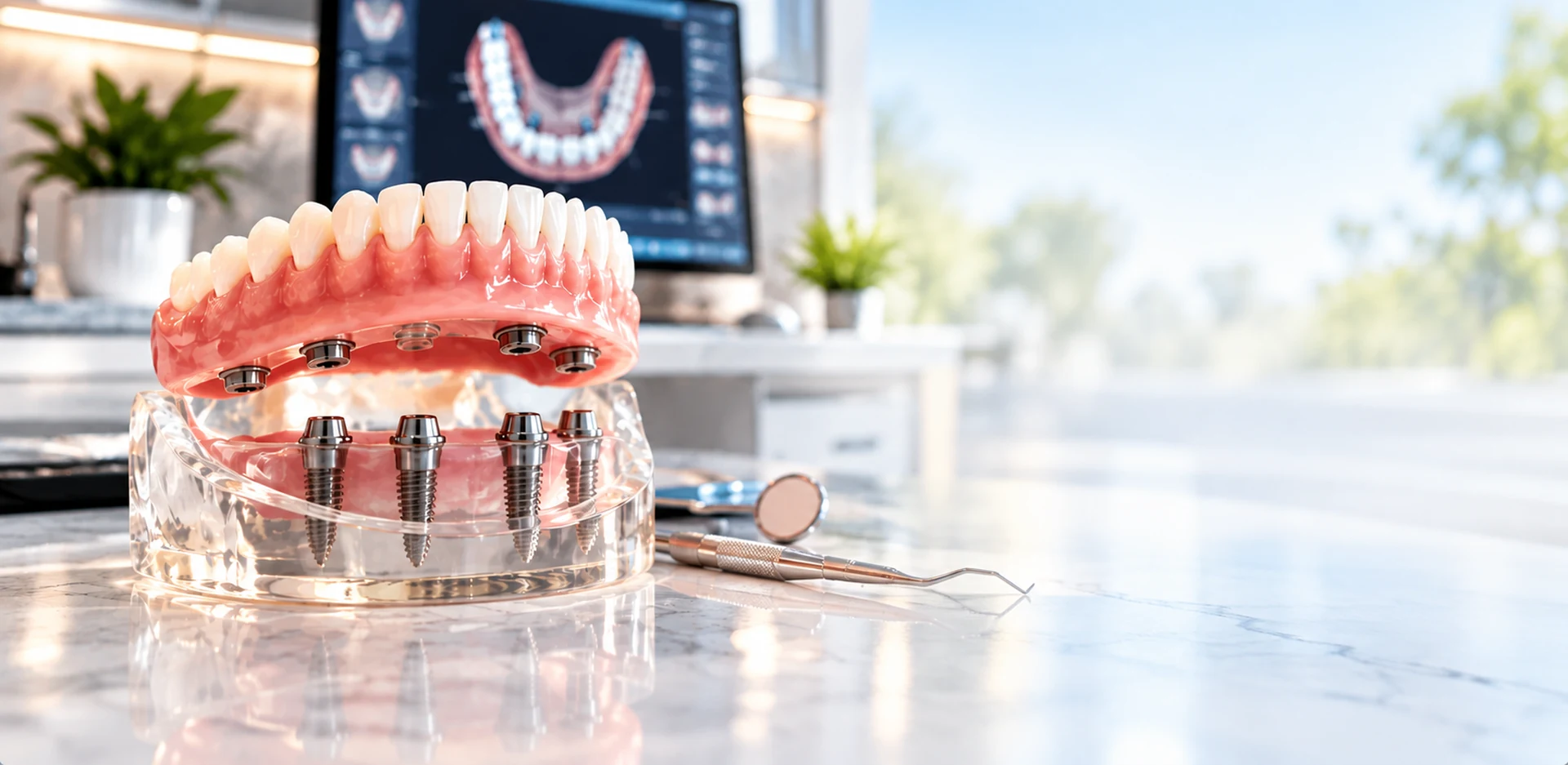
Adding implants can change how the denture is retained. Attachments built into the denture connect to implant components in the mouth, helping the prosthesis resist movement while still allowing the patient to remove it for cleaning.
This can be especially valuable for the lower arch, where conventional dentures often have less surface area and are challenged by the tongue and floor of the mouth. It can also be used in the upper arch, although upper-arch planning is different and may require a different number or distribution of implants.
KNOW WHAT YOU ARE CHOOSING
Conventional denture, implant overdenture or fixed full-arch teeth?
All three can replace a full arch of missing teeth, but they behave differently day to day.
Conventional complete denture
Rests on the gum and underlying ridge. It is removable and does not use implants. Fit can change as the ridge changes over time.
Implant-retained overdenture
Remains removable, but attachments connect the denture to dental implants for added retention and stability. Cleaning access is usually straightforward because the patient removes it.
Fixed full-arch implant teeth
A prosthesis is secured to implants and is not removed by the patient for daily cleaning. It requires a different implant, restorative-space, hygiene and maintenance discussion.
For the right patient, removability is a feature — not a compromise.
Being able to remove the denture can simplify cleaning around implant attachments and under the prosthesis. Some patients prefer that access and the lower cost or simpler repair pathway compared with a fixed full-arch restoration. Others strongly prefer teeth that remain fixed. The consultation should identify which tradeoffs matter to you.
HOW THE DENTURE CONNECTS
“Snap-in denture” describes the experience, not one universal attachment
The actual connection can be designed in different ways. The choice affects retention, space, hygiene, repair and how the denture is loaded.
Individual stud-style attachments
Each implant receives an attachment that engages a replaceable insert inside the denture. Inserts can wear over time and may need periodic replacement.
Bar-retained overdenture
Several implants can be connected by a bar. The denture engages the bar rather than relying only on individual attachments. This can change support, space and hygiene requirements.
Implant-supported vs implant-retained
Some designs rely more heavily on implants for support; others still share support with the gum and ridge. The exact design should be planned from the anatomy and prosthesis, not chosen by nickname.
HOW MANY IMPLANTS?
Two implants can transform some lower dentures — but “two implants” is not a universal prescription
A two-implant mandibular overdenture is a well-established treatment concept and has strong evidence for improving satisfaction and function compared with a conventional lower denture.
That evidence does not mean every lower denture should use exactly two implants, and it does not mean the same design should automatically be used in the upper jaw. Bone, implant distribution, bite, attachment type, existing denture design, opposing teeth and the amount of support expected from the implants all matter.
Bright Smiles plans the implant number and positions around the final denture and the maintenance strategy.
Questions that change the design
- Upper or lower arch?
- How much ridge support remains?
- What opposes the denture?
- How much retention is desired?
- Is a bar or individual attachment better?
- Can the denture be cleaned and repaired predictably?
FROM LOOSE DENTURE TO PLANNED RETENTION
What the treatment journey can look like
The sequence depends on whether you already have a denture, whether teeth need to be removed, whether grafting is needed, and whether a new denture is being made.
01 — Consultation & diagnosis
We evaluate the denture, gums, ridge, bite, health history and what specifically bothers you about your current situation.
02 — 3D implant planning
Appropriate imaging and digital records help us evaluate bone, anatomy, restorative space and positions that will work with the planned prosthesis.
03 — Implant placement
Implants are placed according to the treatment plan. In selected cases other procedures, such as extractions or grafting, may occur before or at the same stage.
04 — Healing phase
The implants need time to integrate with the bone. Your temporary or existing denture plan is determined before surgery so you know how you will function during healing.
05 — Attachment phase
Once the implants are ready, attachment components are connected and the denture is fabricated, picked up, relined or converted depending on the plan.
06 — Bite & fit adjustments
A stable connection does not eliminate the need for a comfortable base, balanced bite and appropriate tooth position. Adjustments are part of delivery.
07 — Learn the cleaning routine
We show you how to clean the denture, attachments, implant areas and any spaces where plaque can accumulate.
08 — Maintenance over time
Attachment inserts, denture teeth, acrylic, screws or components can wear. Regular implant and denture maintenance helps identify problems early.
THE FOUNDATION STILL MATTERS
Do implant dentures always require bone grafting?
No. Some patients have enough bone for the planned implant positions; others need site development or a different implant strategy.
Bone quantity & implant position
The goal is not simply to find any area that can accept an implant. The implants must be positioned so the attachment system and denture can be designed correctly.
Existing denture evaluation
A current denture may sometimes serve as a temporary or be modified, but worn teeth, poor fit, fractures, inadequate thickness or wrong tooth position can make a new prosthesis the better choice.
Grafting when it adds value
Bone grafting may be considered when the planned implant position lacks the necessary ridge dimensions. The amount of grafting should be driven by the prosthetic plan.
PLANNING THE IMPLANTS AROUND THE PROSTHESIS
Digital planning helps connect the implant positions to the denture that will use them
Bright Smiles uses 3D diagnostics and digital planning to evaluate the relationship between bone, implant position and the final restoration. When implant placement is part of the plan, technology availability varies by office.
CBCT & restorative planning
Three-dimensional imaging can help evaluate available bone and anatomy. The implant plan is then considered together with restorative space, attachment position and denture design.
Yomi® in Cumming
Our Cumming office has Yomi robotic implant guidance available for appropriate implant procedures. The dentist remains in control while the technology helps translate a digital plan.
X-Guide® in Lawrenceville
Our Lawrenceville office has X-Guide dynamic navigation available for appropriate implant procedures, providing real-time guidance relative to the digital plan.
LONG-TERM SUCCESS
Implants can stabilize a denture, but they do not make it maintenance-free
A removable implant denture should be removed for thorough cleaning according to the instructions you receive. Plaque can accumulate on the prosthesis, around attachments and around the implants just as it can around natural teeth.
Attachment inserts can lose retention, denture bases can need adjustment as tissues change, and teeth or acrylic can wear. The bite also changes over time as natural opposing teeth wear or move.
Bright Smiles includes implant-specific maintenance in ongoing hygiene care so the implants, soft tissues, bite and prosthetic components can be evaluated.
Call us if you notice
- A sudden loss of retention
- Rocking that was not present before
- A cracked denture or broken tooth
- Bleeding, swelling or persistent soreness
- An implant component that feels loose
- A bite that suddenly feels different
COST, INSURANCE & FINANCING
Understand the entire treatment plan — not just one procedure fee
Cost depends on the number of implants, whether extractions or grafting are needed, the attachment design, whether an existing denture can be used, and whether a new denture is fabricated.
A removable implant overdenture can be financially different from a fixed full-arch restoration because the prosthesis, implant count and laboratory design are different. The least expensive option is not automatically the best value if it does not solve the problem that brought you in.
We accept your insurance and will help you maximize your available benefits. Coverage varies by plan and procedure. Financing options may also be available for qualifying patients.
CARE CLOSE TO HOME
Implant care across Bright Smiles
Implant-supported denture consultations are available through Bright Smiles. Surgical technology and sedation options vary by office, so we coordinate the plan with the location and procedure.
Cumming
907 Buford Rd, Suite 100
Cumming, GA 30041
678-922-8282
Yomi® robotic implant guidance
IV sedation available for appropriate cases
Open Monday–Saturday, 8 AM–5 PM
Lawrenceville
845 Scenic Hwy S, Suite 300
Lawrenceville, GA 30046
770-277-5588
X-Guide® dynamic implant guidance
Monday–Friday, 8 AM–5 PM
Second and fourth Saturdays, 8 AM–5 PM
Dawsonville
78 Dawson Village Way N, Suite 170
Dawsonville, GA 30534
706-525-7127
Comprehensive Bright Smiles implant and restorative care
Monday–Friday, 8 AM–5 PM
FREQUENTLY ASKED QUESTIONS
Implant-supported denture questions, answered clearly
Are implant-supported dentures the same as snap-in dentures?
“Snap-in denture” is a common patient term for a removable denture that connects to dental implants with attachments. The exact attachment design can vary.
Are implant-supported dentures removable?
Many are removable by the patient for daily cleaning. A fixed full-arch implant restoration is a different category of treatment and is not removed by the patient.
How many implants are needed for an implant denture?
There is no single number for every patient. Two implants are a common design for some lower overdentures, while other lower or upper-arch plans may use more implants depending on anatomy, support, attachments and restorative goals.
Will implants stop my denture from moving?
Implants can substantially improve retention and resistance to movement, but the final result still depends on denture fit, attachment design, bite and maintenance.
Can my existing denture be converted to an implant denture?
Sometimes. The denture has to have acceptable fit, tooth position, strength and enough space for the attachment components. In other cases a new denture is more predictable.
Do I have to go without teeth while the implants heal?
Usually there is a temporary-tooth or denture plan, but the exact approach depends on extractions, surgical sites, the existing denture and whether it can be safely worn during healing.
Do implant dentures need adhesive?
A well-designed implant overdenture may reduce or eliminate the need for adhesive for retention, but the answer depends on the prosthesis, number of implants and attachment design.
Can I sleep in an implant denture?
Your dentist will give you specific instructions. Many removable dentures are taken out for part of the day or overnight to allow cleaning and tissue rest, but follow the plan given for your prosthesis.
What wears out on an implant denture?
Attachment inserts, denture teeth and acrylic can wear. Denture bases may need adjustment, and implant components and the bite require periodic evaluation.
Is an implant denture easier to clean than fixed full-arch teeth?
A removable prosthesis can provide direct access to the denture and implant attachments for cleaning. Fixed prostheses require cleaning underneath the restoration with specialized techniques.
Do I need bone grafting first?
Not always. Grafting is considered when bone quantity or shape is inadequate for the planned implant position. Some patients can proceed without grafting.
Can I get implant dentures on the upper jaw?
Yes, but upper-arch anatomy and biomechanics are different from the lower jaw. Implant number, distribution and attachment design should be planned specifically for the upper arch.
What if I want teeth that never come out?
A fixed full-arch implant restoration may be more consistent with that goal. We can compare the surgical, restorative, cleaning, maintenance and cost differences during your consultation.
Does insurance help with implant-supported dentures?
We accept your insurance and will help you understand and maximize the benefits available to you. Coverage varies by plan and by the surgical and prosthetic procedures involved.
RELATED CARE
Build the treatment plan around the whole mouth
You should not have to choose between “a denture” and “full-arch implants” before you understand the middle ground.
If your denture moves, requires constant adhesive, limits what you eat or simply never feels secure, an implant-retained removable option may be worth evaluating.
We will compare conventional, removable implant-supported and fixed implant options so the recommendation fits your anatomy, cleaning preferences, goals and budget.
Cumming • Lawrenceville • Dawsonville
3D implant planning • Advanced implant technology • Sedation options