


 Cumming • Lawrenceville • Dawsonville
 Advanced implant planning
 Sedation options
 Comprehensive restorative care

What can it replace?
Most or all teeth in an upper or lower arch.

How does it work?
Dental implants support a complete set of replacement teeth.

Can teeth be placed right away?
A provisional set of teeth may be possible at implant placement in appropriately selected cases.

Is sedation available?
Yes. Bright Smiles offers multiple comfort and sedation options based on the patient, procedure and location.
WHEN THE BIGGER PICTURE MATTERS
When repairing one tooth at a time is no longer the right answer
Losing teeth rarely happens all at once. Sometimes it is years of broken teeth, repeated dental work, gum disease, failing bridges, loose dentures or teeth that have become increasingly difficult to maintain.
Eventually, the more important question may no longer be “How do we repair this tooth?” It may be “What is the most predictable way to rebuild my smile as a whole?”
Full-arch implant treatment is designed for situations in which most or all of the teeth in an arch are already missing or have a poor long-term prognosis. The goal is not simply to replace teeth. It is to create a stable, functional and maintainable foundation for eating, speaking and smiling comfortably again.
THE TREATMENT
What are full-arch dental implants?
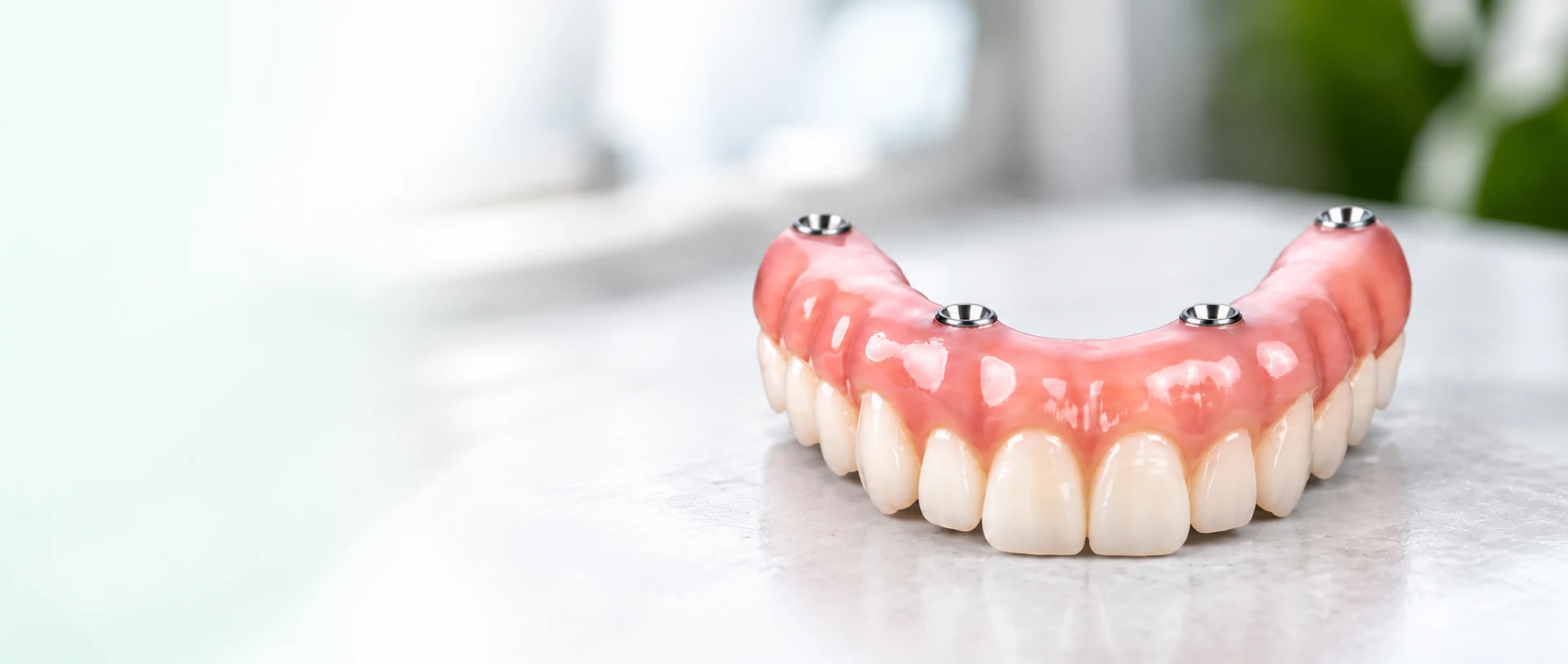
Full-arch dental implant treatment uses a series of dental implants placed in the jaw to support a complete set of replacement teeth for the upper arch, lower arch or both.
Unlike a traditional removable denture that primarily rests on the gums, an implant-supported full arch gains stability from implants anchored in the jawbone.
The number, position and type of implants are determined by the patient's anatomy, available bone, bite, restorative design and treatment goals.
It does not always mean exactly four implants.
Some patients may be treated with four implants, while another treatment plan may use additional implants or a different configuration.
That distinction matters because the treatment should be designed around the patient — not around a predetermined number of implants.
You are not buying “four implants.”
You are rebuilding an entire system of teeth, implants, bone, bite and function.
UNDERSTAND YOUR OPTIONS
Not every full-mouth solution is the same
Different solutions can solve different problems. The right recommendation depends on anatomy, health, expectations, maintenance ability and priorities.
Fixed Full-Arch Implant Teeth
A complete set of replacement teeth is secured to dental implants and is not routinely removed by the patient.
- Greater stability
- A fixed-feeling restoration
- Strong chewing function
- Implant-supported rather than primarily gum-supported
Implant-Supported Dentures
Dental implants help stabilize a removable denture. The denture can still be removed for cleaning but may offer substantially improved retention.
Traditional Dentures
A removable replacement for missing teeth that does not require dental implants. Traditional dentures remain appropriate for many patients.
THE BRIGHT SMILES DIFFERENCE
Full-arch treatment without a fragmented experience
Complex implant treatment is more than placing implants. It can include diagnosis, extractions, bone management, guided placement, provisional teeth, restorative design, a final prosthesis and long-term maintenance. Bright Smiles brings those pieces together within one dental organization.
3D diagnosis & planning
We evaluate the teeth, jawbone, bite and restorative space before determining implant positions.
Implant surgery
Implants are positioned according to the surgical and restorative treatment plan.
Restorative planning
The final teeth are designed around function, bite, appearance and long-term maintenance — not merely around where an implant can be placed.
Provisional teeth when appropriate
Some patients may qualify for provisional teeth during healing. This is determined case by case.
Final restoration
After appropriate healing, the definitive full-arch restoration is completed according to the treatment plan.
Long-term maintenance
Implants and full-arch restorations require professional maintenance and excellent home care.
WATCH & LEARN
See full-arch implant treatment in more detail
Watch this video to learn more about full-arch implant treatment and the ideas patients commonly want to understand before an implant consultation.
Your treatment may be different from what is shown in a general educational video. A Bright Smiles dentist will evaluate your teeth, bone, bite, health history and goals before recommending a treatment plan.
ADVANCED IMPLANT TECHNOLOGY
Advanced planning for complex implant treatment
Full-arch treatment requires precise coordination between planned implant positions and the teeth those implants will support. Bright Smiles uses advanced digital and guided technologies to help plan and deliver implant treatment.
Cumming: Yomi® robotic implant guidance
Our Cumming office has access to Yomi robotic technology for appropriate implant procedures. Yomi can assist the dentist with digitally planned implant positioning while the treating dentist remains in control of the procedure.
Lawrenceville: X-Guide® dynamic guidance
Our Lawrenceville office has access to X-Guide for appropriate implant procedures. X-Guide provides real-time navigational guidance that can help translate a digital implant plan during surgery.
Digital treatment planning
Digital imaging, scanning and restorative planning help connect the surgical phase of implant treatment with the design of the replacement teeth.
Technology assists clinical care; it does not replace the dentist's judgment.
COMFORT MATTERS
Complex dentistry does not mean you have to white-knuckle your way through it
Dental anxiety is common — particularly for patients who have delayed treatment or know they need extensive dental work.
Nitrous oxide is available across our Bright Smiles offices.
IV sedation is currently available in Cumming for appropriate patients and procedures.
Your dentist will review your health history, treatment needs and concerns before recommending the appropriate approach.
YOUR TREATMENT JOURNEY
What does full-arch implant treatment involve?
The exact sequence varies, but most cases move through diagnosis, planning, surgery, healing and restorative completion.
Consultation
We begin with what is bothering you, what you want to change and what you hope treatment will allow you to do again.
Diagnostic evaluation
Your dentist evaluates remaining teeth, gums, bone, bite, medical history and restorative needs using appropriate imaging and digital diagnostics.
Treatment design
We determine whether teeth can be retained, whether bone procedures are needed, how implants should be positioned and what restoration is appropriate.
Surgery
Treatment may include removal of failing teeth, preparation of implant sites and placement of dental implants.
Provisional teeth
When implants and clinical conditions allow, provisional teeth may be placed during healing. Immediate provisional teeth are not guaranteed for every patient.
Healing
The implants need time to integrate with surrounding bone. Your dentist monitors healing and makes adjustments as needed.
Final teeth
After appropriate healing and verification of the implant foundation, definitive teeth are fabricated and delivered according to the restorative plan.
Maintenance
We continue caring for the implants, gums, bite and restoration after treatment is completed.
COMPLEX CASES
“I was told I don't have enough bone.”
Being told you have bone loss does not automatically mean implant treatment is impossible. It does mean the treatment needs to be properly evaluated.
Depending on the location and amount of available bone, treatment planning may involve procedures such as ridge augmentation, socket preservation, or a sinus lift.
The appropriate approach depends on the individual anatomy and treatment plan.
CANDIDACY
Could full-arch dental implants be right for you?
Full-arch implant treatment may be considered when a patient:
- Has already lost most or all teeth in an arch
- Has multiple teeth that are severely damaged or failing
- Is struggling with an unstable or uncomfortable denture
- Wants to explore a more stable implant-supported solution
- Has undergone repeated dental treatment but still has a poor overall prognosis
- Is prepared to maintain the implants and restoration long term
Bone volume, gum health, nicotine use, certain medical conditions, medications and the ability to maintain the restoration can influence the treatment plan. A clinical examination and diagnostic imaging are necessary before determining candidacy.
When full-arch implants may not be the best answer
If healthy, maintainable teeth can be predictably preserved, removing them simply to place implants may not be the best treatment.
Likewise, a removable solution may make more sense for some patients because of anatomy, health, hygiene requirements, finances or personal preference.
Our goal is not to fit every patient into the same implant solution. It is to determine which teeth can reasonably be maintained, what cannot be predictably saved, and which treatment gives you the most sensible long-term path forward.
A COMMON QUESTION
Is full-arch implant treatment the same as All-on-4?
Not exactly. Full-arch dental implants describe the broader category of treatment in which implants support a complete arch of replacement teeth.
The term All-on-4 is commonly associated with a treatment concept in which a complete arch is supported by four strategically positioned implants.
Some full-arch cases may use four implants. Others may use a different number or configuration based on anatomy, restorative needs and clinical judgment. At Bright Smiles, the treatment plan is designed around the patient rather than committing every patient to a predetermined implant number.
What will the final teeth be made from?
The final restorative design depends on the treatment plan. For appropriate cases, zirconia full-arch teeth can provide a strong, highly aesthetic definitive restoration.
Material selection takes into account bite forces, restorative space, implant position, appearance, maintenance and other clinical considerations.
COST & FINANCING
How much do full-arch dental implants cost?
There is no responsible single price for every full-arch case because treatment can vary substantially.
Cost may be affected by:
- Whether one arch or both arches are treated
- The number and condition of remaining teeth
- Number and type of implants
- Whether extractions are required
- Bone grafting or other surgical procedures
- Sedation
- Provisional restorations
- Design and material of the definitive teeth
- Complexity of the bite and restorative needs
We review the recommended treatment and expected fees before treatment begins.
Using dental insurance
We accept your insurance and will help you maximize your available benefits. Coverage varies by plan and procedure, and our team can help you understand the benefits that may apply. Financing options may also be available for qualifying patients.
CARE CLOSE TO HOME
Advanced implant care across Bright Smiles
Choose the Bright Smiles location that works best for you. Specific technology, sedation and provider availability can vary by location.
Cumming
907 Buford Rd, Suite 100
Cumming, GA 30041
678-922-8282
Yomi® robotic implant guidance
IV sedation available for appropriate cases
Open Monday–Saturday
Lawrenceville
845 Scenic Hwy S, Suite 300
Lawrenceville, GA 30046
770-277-5588
X-Guide® dynamic implant guidance
Open second and fourth Saturdays
Dawsonville
78 Dawson Village Way N, Suite 170
Dawsonville, GA 30534
706-525-7127
Comprehensive Bright Smiles dental and implant care for Dawsonville and surrounding North Georgia communities.
FREQUENTLY ASKED QUESTIONS
Full-arch implant questions, answered clearly
Are full-arch dental implants permanent?
Dental implants are intended as a long-term tooth-replacement foundation, but no dental treatment should be described as guaranteed for life. Implant health and restoration longevity depend on oral hygiene, maintenance, bite forces, medical health and habits.
Can I get teeth the same day my implants are placed?
Some patients can receive a provisional set of teeth at or near the time implants are placed. Whether immediate provisional teeth are appropriate depends on implant stability, bone, bite, surgical findings and the overall treatment plan.
How many implants are needed for a full arch?
There is no single number that is right for every patient. Some treatment designs use four implants, while others may use additional implants. The number and positions should be planned around anatomy and restorative needs.
Do full-arch dental implants come out at night?
A fixed full-arch restoration is secured to the implants and is not routinely removed by the patient. Implant-supported removable dentures are a different treatment option and are designed to be removed.
Are full-arch implants better than dentures?
Neither treatment is automatically better for every patient. Implant-supported fixed teeth generally provide greater stability, while traditional dentures may be more appropriate because of health, anatomy, maintenance requirements, preference or cost.
What if I already wear dentures?
Existing denture wearers may still be candidates for implant-supported treatment. Your dentist needs to evaluate jawbone, gum tissues, bite, medical history and treatment goals.
Can you do full-arch implants if I have bone loss?
Bone loss does not automatically rule out implant treatment. Some patients may require additional planning or procedures such as ridge augmentation or sinus grafting. Diagnostic imaging is necessary to determine available options.
Will I be asleep during the procedure?
Not necessarily. Bright Smiles offers different comfort and sedation options depending on the procedure, patient and location. Nitrous oxide is available across our offices, and IV sedation is currently available in Cumming for appropriate patients.
How long does full-arch implant treatment take?
The complete process commonly includes a surgical phase, healing period and delivery of the definitive restoration. The exact timeline varies depending on extractions, bone procedures, healing and the individual treatment plan.
Do dental implants require special cleaning?
Yes. Implant-supported restorations still require daily home care and professional maintenance. The cleaning technique may differ from natural teeth, and our team will provide instructions based on the final restoration.
Can my failing teeth be saved instead?
Sometimes. A comprehensive evaluation is necessary before deciding to remove teeth. If teeth can be predictably maintained, preserving them may be preferable to extracting them solely to place implants.
Does dental insurance cover full-arch implants?
Benefits vary significantly by plan. We accept your insurance and will help you understand and maximize the benefits available to you. Our team can review expected treatment costs and applicable benefits before treatment.
RELATED CARE
Your treatment may connect with other Bright Smiles services
You don't have to know which implant treatment you need before you come in.
If you are dealing with failing teeth, missing teeth or a denture that no longer gives you the stability you want, start with an evaluation.
We'll assess your teeth, bone, bite and goals, explain the realistic options, and help you understand the advantages and tradeoffs of each approach.
Cumming • Lawrenceville • Dawsonville
Advanced implant technology • Sedation options • Comprehensive dental care