



What does TENS feel like?
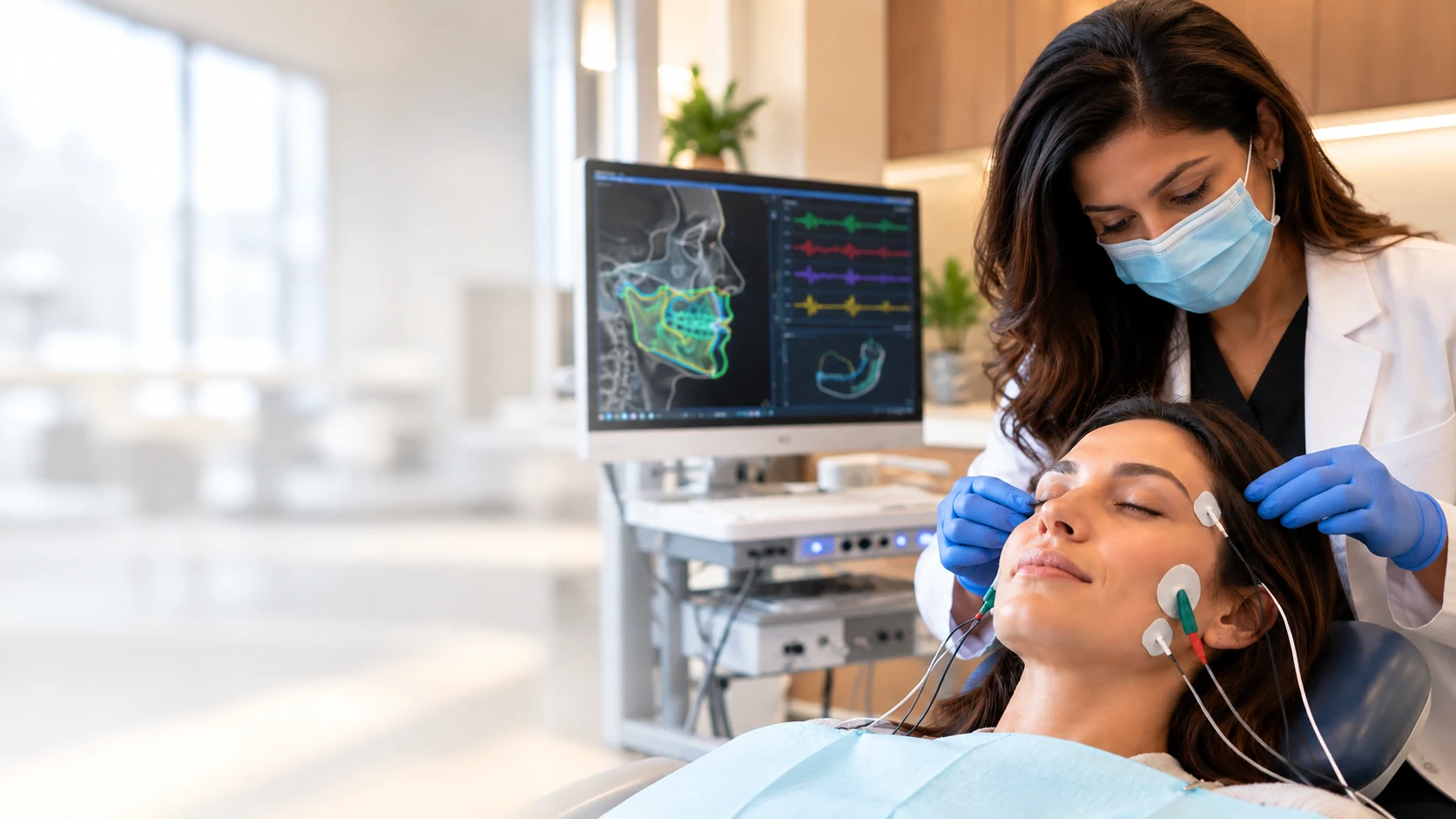
Patients usually feel a rhythmic tingling or muscle pulsing under the electrodes. The intensity is adjusted for comfort and the clinical purpose.
Does TENS cure TMJ disorders?
No. It may temporarily reduce muscle tension or discomfort and can be useful during evaluation, but the underlying cause of symptoms still needs to be identified.

Why use TENS before a bite registration?
Relaxing the chewing muscles can help the clinician compare the habitual bite with a jaw position recorded under reduced muscle tension.

Can everyone use TENS?
No. Medical history and implanted electrical devices or other contraindications must be reviewed before treatment.
A TOOL FOR MUSCLE RELAXATION
TENS can change how the muscles feel without telling us why they were tense.
Jaw-muscle pain can develop from clenching, overuse, protective guarding around a painful joint, dental problems or other causes. TENS may temporarily reduce muscle activity and discomfort, which can be clinically useful.
What happens after the muscles relax must still be interpreted alongside the examination, history and other diagnostic findings.
WHEN TENS MAY BE USED
Common roles in TMJ and neuromuscular care
Jaw-muscle relaxation
Rhythmic stimulation may help reduce protective muscle tension in selected patients.
Short-term symptom relief
Some patients experience temporary reduction in muscle soreness or tightness.
Neuromuscular bite registration
TENS may be used before a bite record when the clinician wants to evaluate jaw position after reducing muscle tension.
Orthotic planning
The response to muscle relaxation can add information when designing or adjusting a therapeutic orthotic.
Functional comparison
Range of motion, tenderness and bite perception before and after TENS can provide useful clinical context.
Conservative care
TENS is reversible and noninvasive, which makes it one possible tool before considering more permanent treatment decisions.
Feeling better after TENS does not prove one specific diagnosis.
Muscle relaxation can be useful information, but it does not by itself establish that the bite is the cause of pain or that permanent dental changes are required.
SCREEN BEFORE STIMULATION
What we review before using TENS
We review the jaw-pain history, medical conditions, implanted electronic devices, pregnancy status when relevant, neurologic history, skin condition where electrodes would be placed and the clinical reason TENS is being considered. If a different problem is more likely to explain the pain, that problem takes priority.
TENS may be inappropriate or require medical clearance when
- The patient has an implanted pacemaker, defibrillator or other electronic medical device
- There are relevant neurologic or seizure concerns
- Electrodes would cross irritated, infected or damaged skin
- The cause of pain appears to be acute dental infection or significant trauma
- The patient has another medical condition for which electrical stimulation needs clearance
WHAT A TENS SESSION MAY INVOLVE
From baseline to reassessment
01 — Baseline exam
Document pain, muscle tenderness, opening and the clinical reason for stimulation.
02 — Electrode placement
Surface electrodes are positioned for the intended jaw-muscle or neuromuscular application.
03 — Controlled stimulation
Intensity is increased gradually to a comfortable therapeutic level for the planned session.
04 — Reassessment
Muscle tenderness, movement and bite perception may be reassessed, and the findings are integrated with the rest of the diagnosis.
AFTER TENS
How the information is used
Notice temporary changes
Muscles may feel looser or less sore for a period after treatment. Duration varies.
Report unusual symptoms
Skin irritation, dizziness, increasing pain or other unexpected symptoms should be reported.
Do not change your bite based on one session
A temporary relaxed position is not, by itself, a reason for irreversible dental treatment.
Use follow-up to test the hypothesis
If TENS supports a neuromuscular treatment concept, response to a reversible orthotic or other conservative therapy provides additional evidence.
INSURANCE & FINANCIAL PLANNING
Know the plan before treatment begins.
We accept your insurance and will help you maximize your benefits. Coverage varies by plan, diagnosis and procedure. Our team can review expected fees, available benefits and payment or financing options before treatment begins.
Treatment recommendations are based on clinical need, not on whether a particular service is covered.
CARE CLOSE TO HOME
Choose the Bright Smiles location that works best for you.
Specific provider, technology and appointment availability can be confirmed when you schedule.
Lawrenceville
845 Scenic Hwy S, Suite 300, Lawrenceville, GA 30046
Dawsonville
78 Dawson Village Way N, Suite 170, Dawsonville, GA 30534
START WITH AN EVALUATION
Talk with Bright Smiles about tens for jaw / tmj pain.
Use the location links to schedule directly. The appropriate treatment is confirmed only after clinical evaluation.
Submitting an online booking request starts the scheduling process; treatment recommendations are made after evaluation.
FREQUENTLY ASKED QUESTIONS
TENS for Jaw / TMJ Pain questions patients ask
The right treatment depends on the individual diagnosis and clinical findings.
What does TENS stand for?
TENS stands for transcutaneous electrical nerve stimulation.
Is dental TENS the same as a home pain-relief unit?
The basic concept is similar, but dental use may involve different electrode placement, settings and clinical goals. Do not substitute a home device for a clinician-directed protocol.
Can TENS relax the jaw muscles?
In selected patients, electrical stimulation can reduce muscle tension and create rhythmic contraction-relaxation patterns.
Can TENS tell where my jaw should permanently sit?
No single TENS session or device measurement should be treated as proof of a permanent ideal bite.
Does TENS help every type of TMJ pain?
No. Joint disease, dental infection, trauma, neuropathic pain and other causes may not respond the same way as muscle-dominant pain.
How long is a session?
Session length depends on the device and clinical purpose. The treating team will explain the planned duration.
Can I use TENS if I have a pacemaker?
Implanted electronic devices can be a contraindication or require medical guidance. This must be reviewed before treatment.
Is TENS painful?
The sensation is usually tingling or pulsing rather than pain. Intensity should remain within a tolerable range.
Can TENS be combined with an orthotic?
Yes, in selected neuromuscular workflows TENS may be used during evaluation and an orthotic may then be used as a reversible therapeutic trial.
Does insurance cover TENS-based TMJ care?
Benefits vary by plan and procedure. We accept your insurance and will help you maximize your benefits.
BRIGHT SMILES DENTISTRY & ORTHODONTICS
If jaw-muscle tension is part of your symptoms, TENS may be a useful conservative tool—but the value comes from how the response fits into the full diagnosis.
Serving Cumming, Lawrenceville and Dawsonville, Georgia.